How does conditional visibility work in Adalo?
Show or hide components based on user data, record values, inputs, dates, and other conditions—and debug the common gotchas.
We checked current official documentation, captured the relevant screens, and compared the workflow with dated Adalo forum reports. Source links and limitations are below so you can judge the evidence directly.
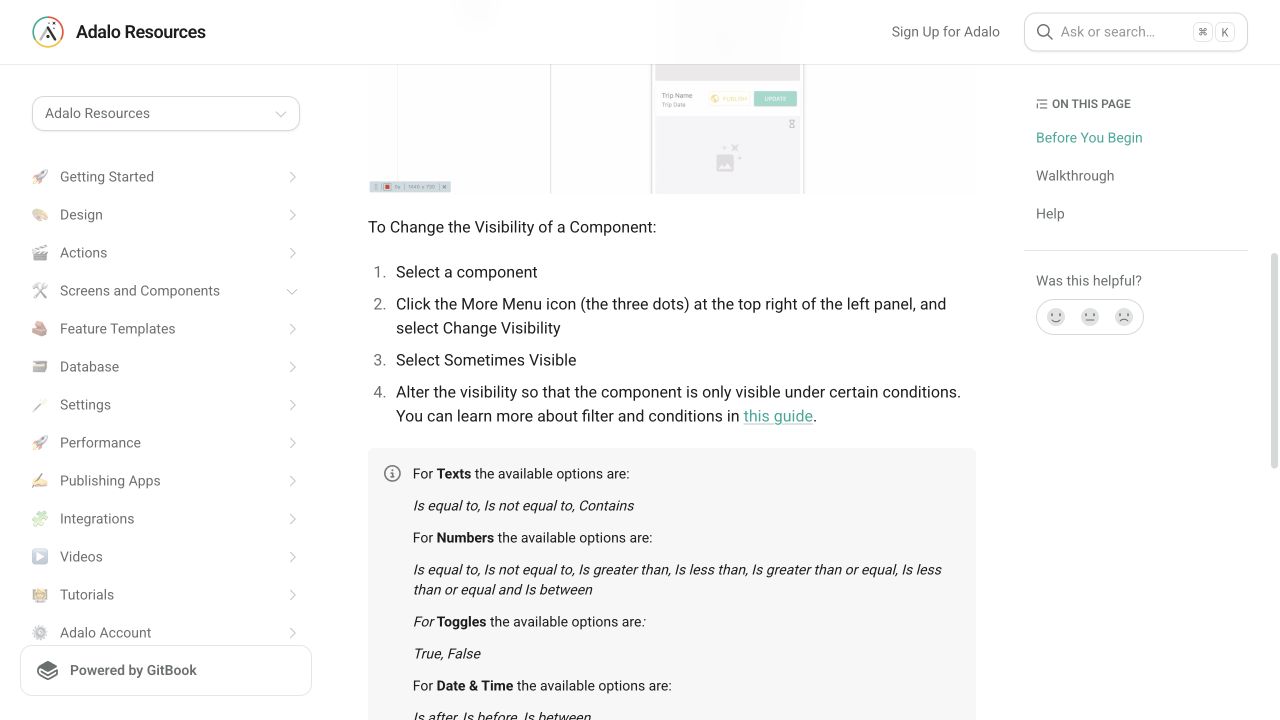
Select the component, open its More menu, choose Change Visibility, set it to Sometimes Visible, and define the condition. The component appears only when that condition evaluates to true.
Conditional visibility evaluates one accessible value and shows the component when the expression is true. Use the smallest component that needs to change, test both sides with deliberate sample data, and verify layout reflow. Hiding a button does not secure an action or record; sensitive behavior still needs appropriate product and backend safeguards.
The intended outcome
A component whose visibility follows one clear, testable rule without breaking the surrounding layout.
Requirements
- A component to control
- A data or component value to evaluate
- Sample records for both true and false states
Step by step
- 01
Select one component
Start with the smallest element whose visibility should change. Grouped components can hide more than intended.
- 02
Open visibility settings
Open the component’s More menu, choose Change Visibility, and switch from Always Visible to Sometimes Visible.
- 03
Choose the available value
Select a value the component can actually access: logged-in user data, current record data, or another component’s input.
- 04
Define one condition
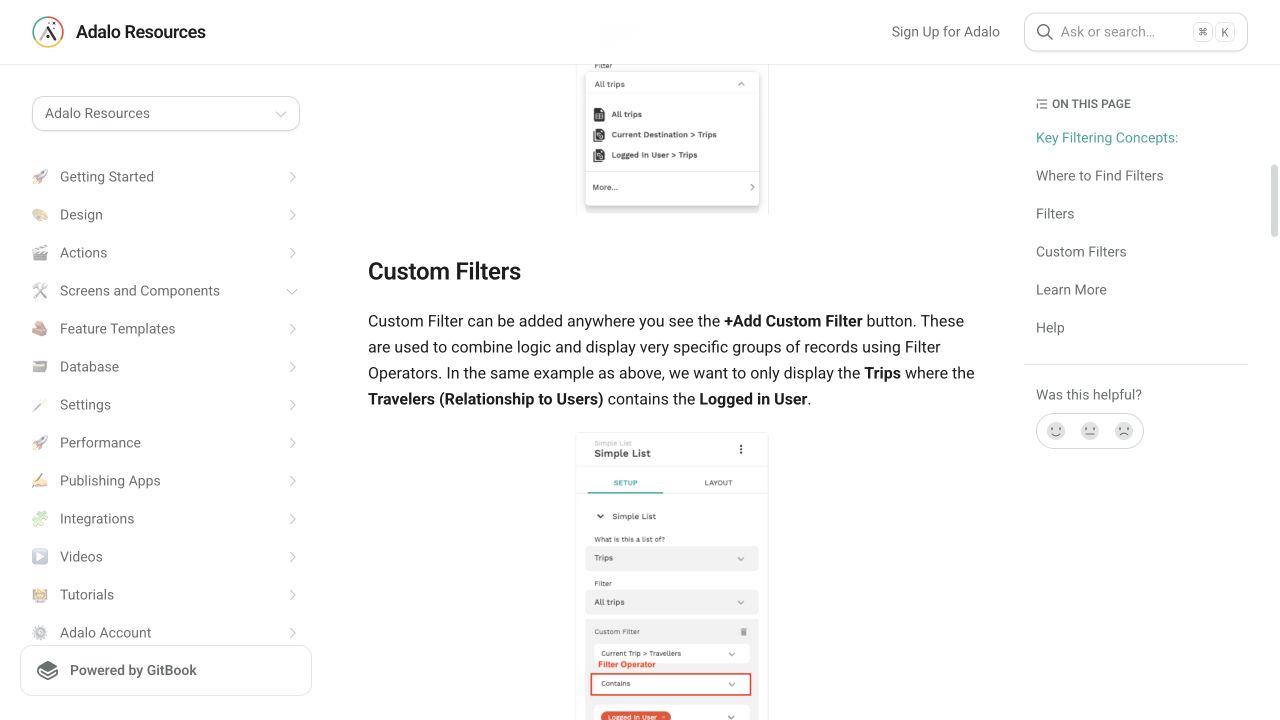
Choose the operator that matches the property type and define the value that makes the component visible.
- 05
Test both sides
Preview once with the condition true and once with it false. Confirm both behavior and layout reflow.
The underlying logic
Conditions are boolean: the expression is either true or false.
Visibility does not filter data; it controls one component’s presence.
Adalo lays screens out top-to-bottom, so hidden elements can affect how later components occupy space.
Data model
| Collection | Important properties | Relationships |
|---|---|---|
| Users | Role, Onboarding Complete | Relates to the records the user may operate |
| Items | Status, Published | Belongs to an owner |
What changed?
- Current documentation places visibility under the component More menu and Sometimes Visible state.
Common failure modes
The condition never becomes true
Confirm the property type, exact value, and whether the component has access to the record you selected.
Empty behaves differently than zero
Treat Empty as no value and 0 as a real number. Test them separately.
The layout jumps when the component hides
Review neighboring groups and component alignment; intentional paired states should occupy compatible positions.
Testing checklist
0 of 8 checked on this device
Current limitations
- Visibility is presentation logic and must not be treated as authorization or data security.
Screenshot evidence
These captures document what Adalo currently publishes and what builders are reporting. They support the written guidance, but they are not a substitute for an end-to-end test in your own app.
What the Adalo community is reporting
These are concise editorial summaries of public forum posts—not endorsements or independently reproduced results.
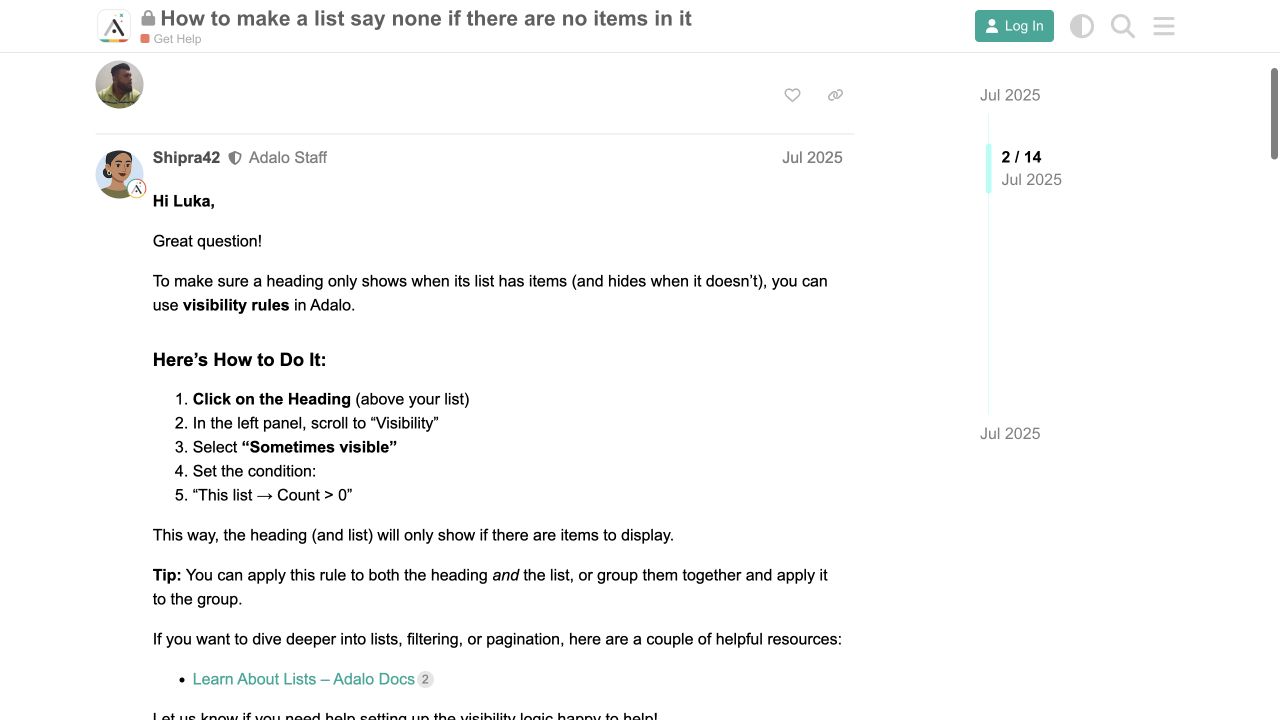
How to make a list say none if there are no items in it
Forum replies describe using Sometimes Visible with a list count and also point to the simple list empty-state feature.
Boundary: Replies disagree about where some list-count options appear, so exact menu availability can vary by component.
Shipra42 and community replies · July 2025Sources and status
This page was last reviewed on Aug 12, 2026. Its current status is Verified from current public evidence.
Verification owner: Adalocado editorial. Next review: Nov 12, 2026.
Changelog
Added current visibility screenshots and a July 2025 forum implementation report.
Did this solve your problem?
Never deal with an Adalo problem again.
Rehost becomes the monthly team behind your app. Fixes, releases, integrations, and ongoing changes have an owner.
See monthly managementBring us the messy version.
Describe what you expected, what happened instead, and what you already tried.
Ask Adalocado 💬