How do you filter by multiple users in Adalo?
Filter Adalo records connected to several users by choosing the right relationship shape, applying Contains and AND/OR rules, and testing known sample data.
We checked current official documentation, captured the relevant screens, and compared the workflow with dated Adalo forum reports. Source links and limitations are below so you can judge the evidence directly.
Model the user-to-record connection first, then filter the list using relationship Contains rules and explicit AND/OR behavior. Many-to-many comparisons have platform limitations, so test the exact relationship shape.
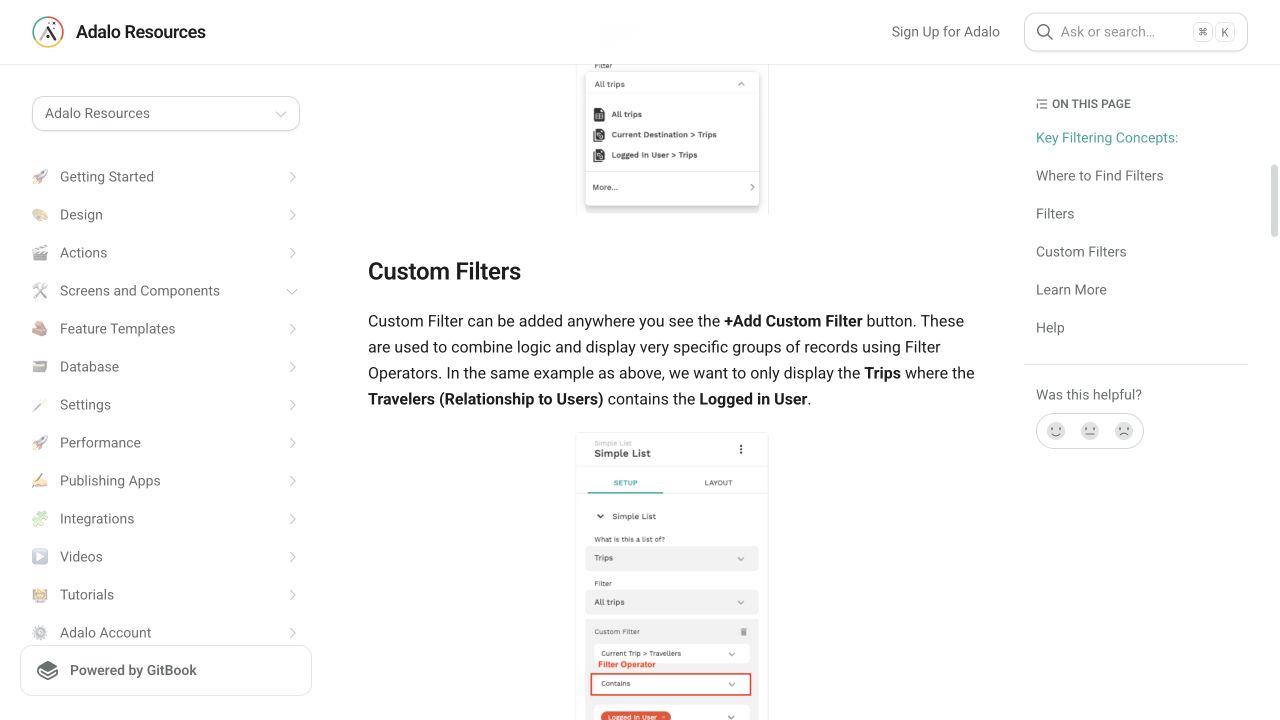
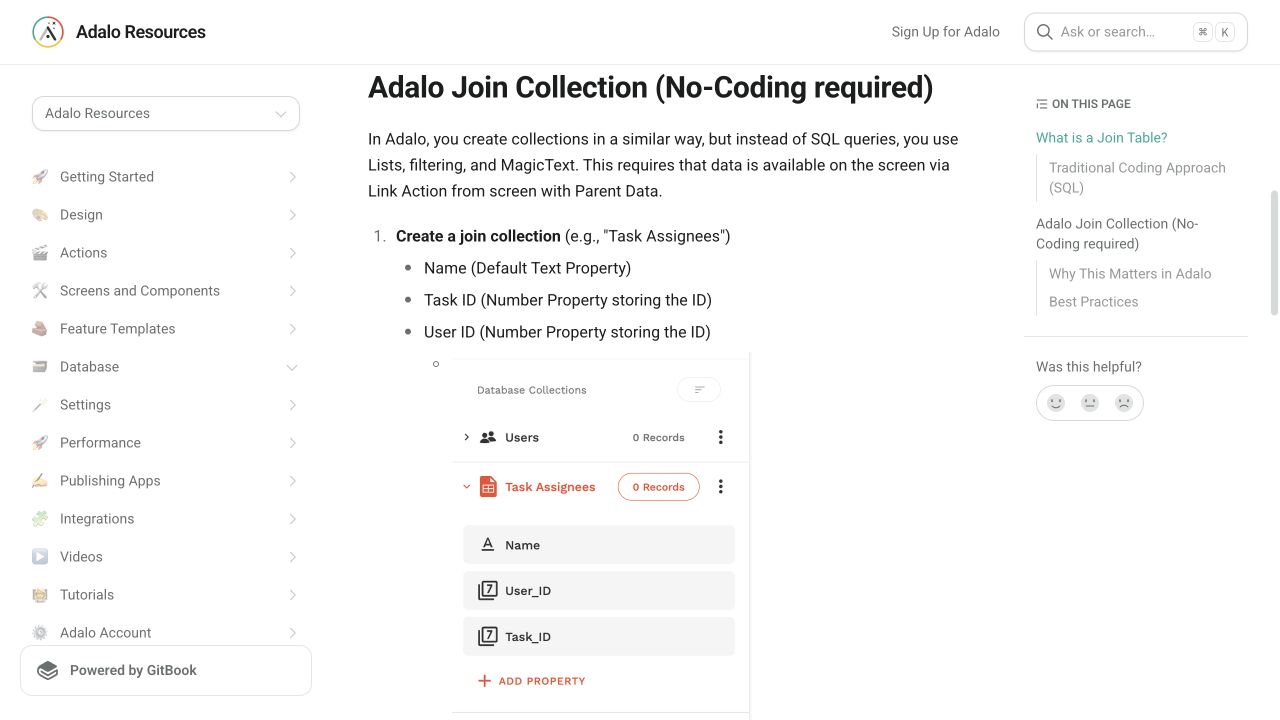
Write the intended set rule in plain language before configuring filters: match any selected user, every selected user, or the logged-in user plus another condition. Model that relationship explicitly and test records that differ by only one membership. Current Adalo documentation limits logical relationship comparison to one-to-many shapes, so a join collection often makes roles, dates, and queries clearer than a dense many-to-many relationship. Protect the records with Collection Permissions; the list filter only shapes what the component displays.
The intended outcome
A filtered list whose rules clearly express which user relationships qualify.
Requirements
- Defined relationship cardinality
- List of records
- Representative multi-user test data
Step by step
- 01
Write the rule in plain language
Decide whether records must contain all selected users, any selected user, or one current user.
- 02
Inspect relationship shape
Confirm whether the record has one user, many users, or a join collection.
- 03
Add filters independently
Prove each Contains or relationship rule before joining filters with AND/OR.
- 04
Test overlaps
Use records connected to neither, one, and multiple users.
The underlying logic
Filter operators compare the current record’s relationship to selected user records.
Current Adalo documentation limits logical relationship comparisons to one-to-many shapes; comparing many records with many records needs a different model.
Collection Permissions are the authorization layer. A Logged-in User list filter alone must not be treated as data security.
Data model
| Collection | Important properties | Relationships |
|---|---|---|
| Users | Name, Role | Has many memberships |
| Records | Name, Status | Has many memberships |
| Memberships | Role, Joined Date | Joins one user to one record |
What changed?
- The refreshed model recommends a membership collection when relationship context or clearer queries are required.
Common failure modes
A many-to-many comparison is unavailable
Use a join collection or reshape the query around a one-to-many relationship.
The filter looks correct but data is exposed
Configure Some Logged In Users collection permissions through the required User relationship; do not rely on component filtering for access control.
Testing checklist
0 of 8 checked on this device
Current limitations
- Many-to-many comparisons can be difficult to express and must be tested with the exact relationship shape.
- A component filter is not an authorization boundary; private records require Collection Permissions.
Screenshot evidence
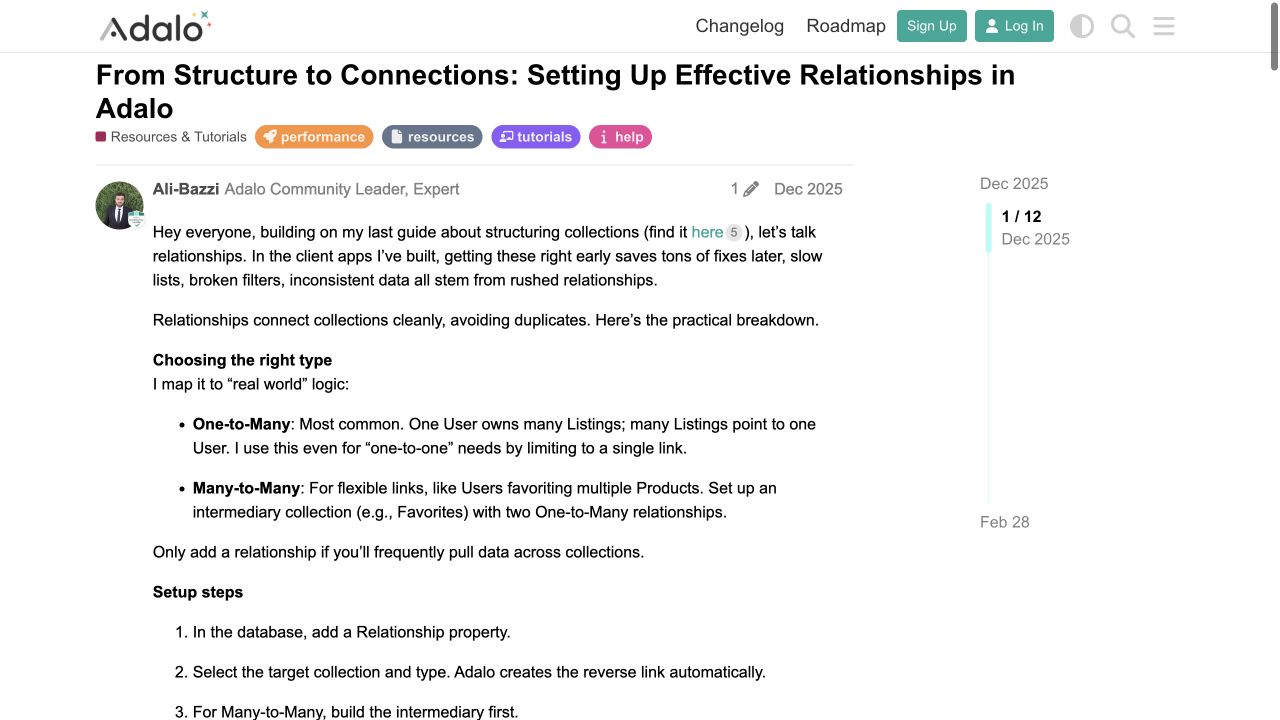
These captures document what Adalo currently publishes and what builders are reporting. They support the written guidance, but they are not a substitute for an end-to-end test in your own app.
What the Adalo community is reporting
These are concise editorial summaries of public forum posts—not endorsements or independently reproduced results.
From Structure to Connections
The discussion recommends intermediary join records for flexible many-to-many cases and explains that metadata such as role or joined date belongs on that record.
Boundary: These are practitioner recommendations; the exact AND or OR expression still depends on the available data context and must be tested with representative records.
Ali-Bazzi, michaelappdev, and replies · December 2025–February 2026Sources and status
This page was last reviewed on Aug 16, 2026. Its current status is Verified from current public evidence.
Verification owner: Adalocado editorial. Next review: Oct 12, 2026.
Changelog
Added the one-to-many logical-operator boundary and separated list presentation from Collection Permissions.
Added current custom-filter and join-collection captures plus recent relationship reports.
Did this solve your problem?
Never deal with an Adalo problem again.
Rehost becomes the monthly team behind your app. Fixes, releases, integrations, and ongoing changes have an owner.
See monthly managementBring us the messy version.
Describe what you expected, what happened instead, and what you already tried.
Ask Adalocado 💬
