Build Foodmood: a matching app in Adalo
Follow the original Foodmood build from friend codes through swipe sessions, profile details, list states, and session IDs.
We checked current official documentation, captured the relevant screens, and compared the workflow with dated Adalo forum reports. Source links and limitations are below so you can judge the evidence directly.
This project preserves the five-part 2021 Foodmood series as one coherent learning path. Treat the videos as architectural history and verify every editor-specific step before using it in a current app.
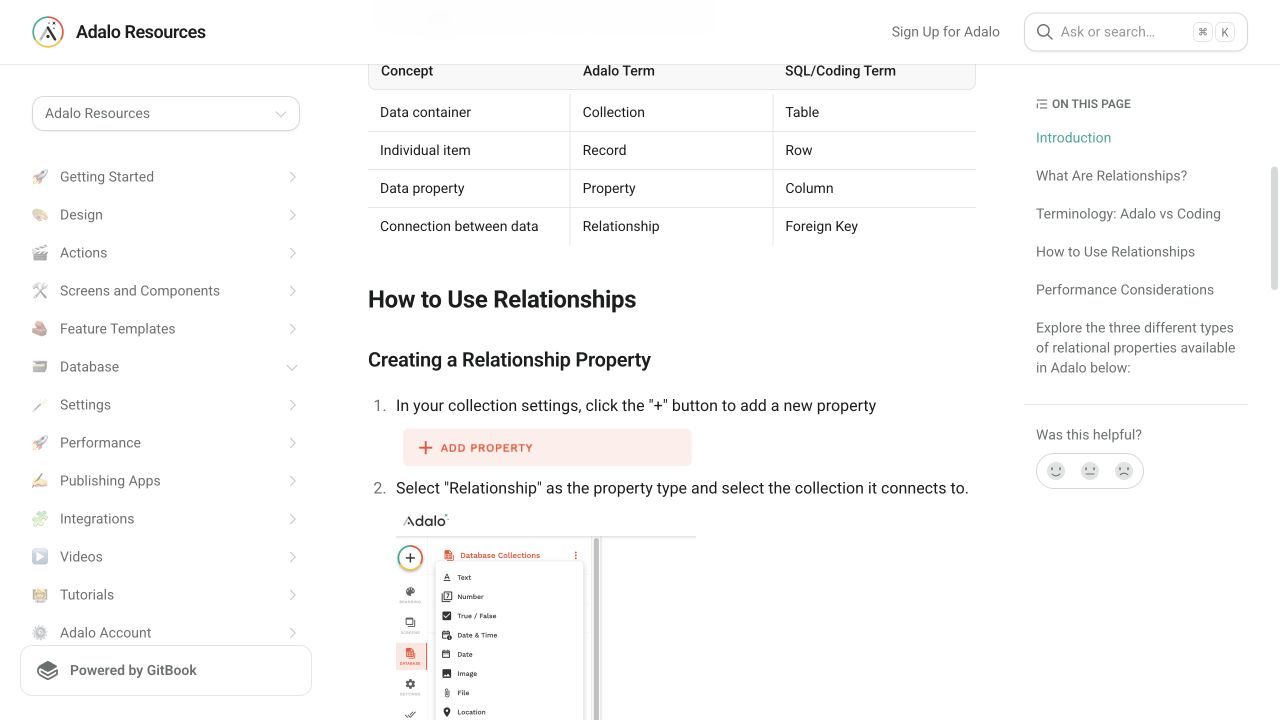
Foodmood is most useful as a complete data-flow case study: create a session, join participants, store each decision, and resolve a match without mixing sessions. Current relationship documentation and recent community guidance support that schema, while the historical screens and complete multi-user sequence remain explicitly unreproduced.
The intended outcome
A structured view of how several Adalo concepts combine in one feature-rich app.
Requirements
- Understanding of collections and relationships
- Comfort with lists and actions
- A test Adalo project
Step by step
- 01
Unique friend codes
Create a lightweight way for users to find and connect with one another.
- 02
Matching swipe sessions
Model a shared session and compare participants’ choices.
- 03
Profile detail screen
Pass a selected user record and present related profile data.
- 04
List states
Represent loading, empty, active, and completed results clearly.
- 05
Session IDs
Use a shared identifier to keep records from the same matching attempt together.
The underlying logic
The project’s durable lesson is orchestration: identity, relationships, temporary sessions, and view states work together.
The exact 2021 UI is not presented as current.
Data model
| Collection | Important properties | Relationships |
|---|---|---|
| Sessions | Code, Status, Created Date | Has many participants and choices |
| Participants | Joined Date | Joins a user to one session |
| Choices | Decision, Created Date | Belongs to a participant, session, and option |
What changed?
- The refreshed project makes session isolation and representative test data explicit.
Project architecture
Foodmood is useful because it crosses multiple boundaries: persistent users, temporary sessions, repeated choices, and results calculated from relationships.
How to use this legacy build
Watch for the reason behind each collection and action. Pause before copying exact clicks, because the builder and marketplace have changed since 2021.
Common failure modes
A chapter’s interface no longer matches
Use the chapter to understand the data flow, then map the idea to current Adalo controls and documentation.
Testing checklist
0 of 7 checked on this device
Current limitations
- The current sources corroborate the relationship architecture, but the five-part build has not been rerun end to end.
Screenshot evidence
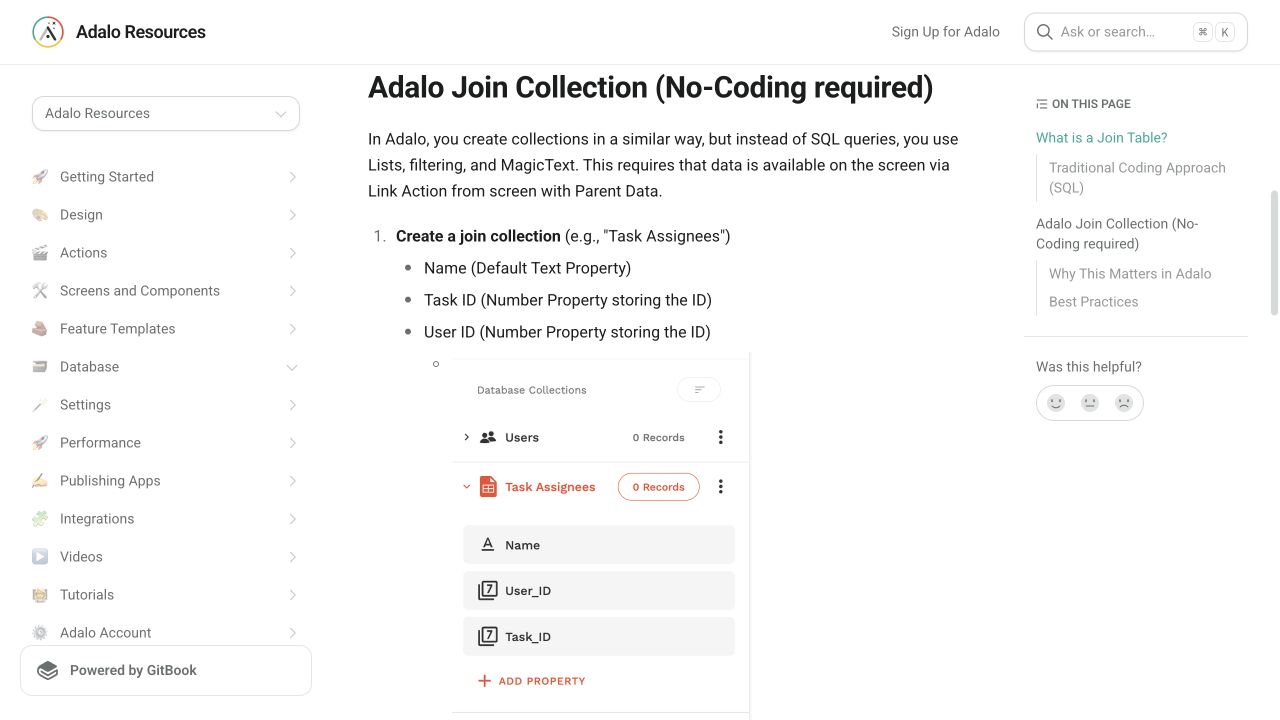
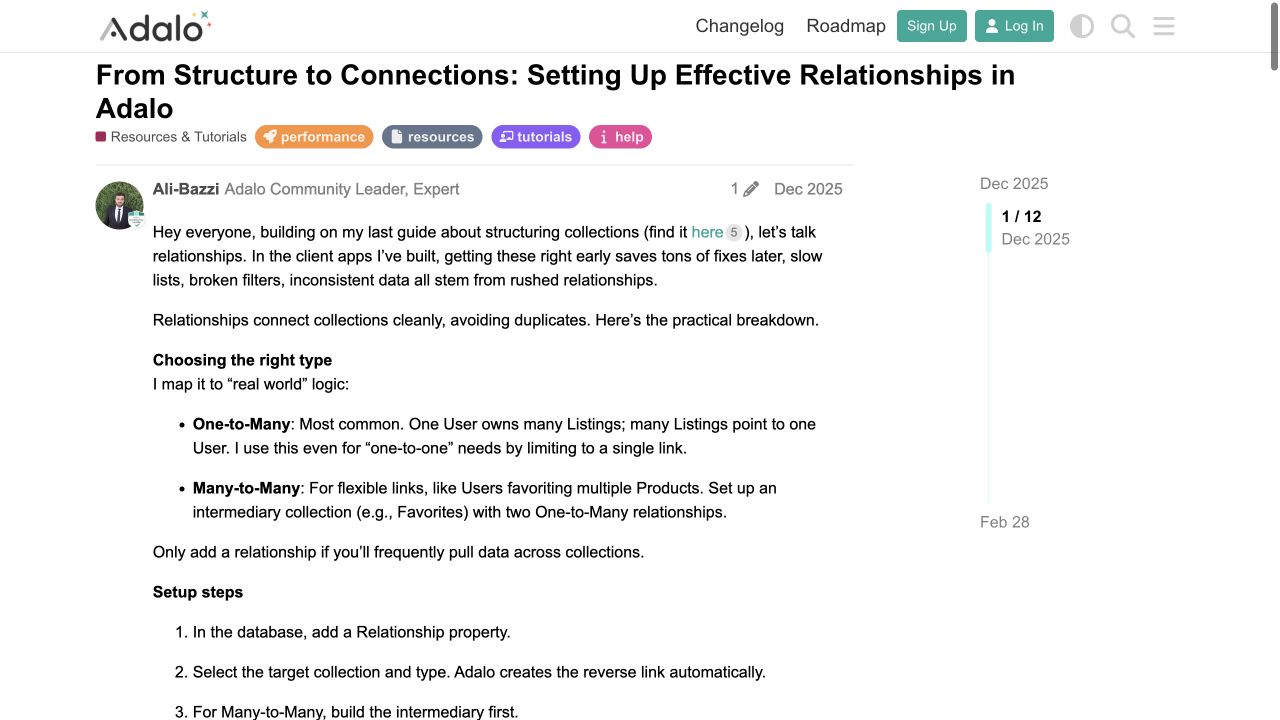
These captures document what Adalo currently publishes and what builders are reporting. They support the written guidance, but they are not a substitute for an end-to-end test in your own app.
What the Adalo community is reporting
These are concise editorial summaries of public forum posts—not endorsements or independently reproduced results.
From Structure to Connections
The discussion supports intermediary collections with two one-to-many relationships and properties on the relationship record, matching the participant and choice architecture.
Boundary: The evidence validates the data-model pattern, not Foodmood’s full multi-user matching sequence or race-condition behavior.
Ali-Bazzi and community replies · December 2025–February 2026Sources and status
This page was last reviewed on Aug 12, 2026. Its current status is Verified from current public evidence.
Verification owner: Adalocado editorial. Next review: Oct 12, 2026.
Changelog
Added current relationship screenshots and forum corroboration while preserving the end-to-end reproduction boundary.
Did this solve your problem?
Never deal with an Adalo problem again.
Rehost becomes the monthly team behind your app. Fixes, releases, integrations, and ongoing changes have an owner.
See monthly managementBring us the messy version.
Describe what you expected, what happened instead, and what you already tried.
Ask Adalocado 💬